On 2 August 2026, Article 50 of the EU's AI Act stopped being something lawyers wrote "will take effect" about. It took effect[1]. If you generate images, audio, video or text with AI and publish it anywhere in the EU (or for EU audiences), this rule applies to you, whether you've noticed or not.
The problem is the internet is full of images of "recommended AI badges" with zero context on who actually has to use them, when, or why. So I put it all in one place: what the rule actually says, what the European Commission's official icons look like, how to use them properly - and, honestly, why I personally don't paste a badge under every single post on Instagram, even though this entire site is about AI.
The idea in short: the content stays the content, the badge just says where it came from
What Article 50 actually says
Article 50 isn't one rule. It's four different obligations stacked together, each for a different role and a different type of content[2]:
- Paragraph 1 - chatbot providers. If you build a system people talk to, they need to know they're talking to AI - unless that's already obvious.
- Paragraph 2 - content-generator providers. Companies like Midjourney, OpenAI or Google have to mark what their systems generate in a machine-readable format, detectable by a tool[2].
- Paragraph 3 - deployers of emotion-recognition and biometric-categorisation systems. A separate category, mostly about companies deploying such systems against other people.
- Paragraph 4 - deployers, meaning you as a user. If you publish a deepfake (image, audio, video) or AI text about public affairs, you have to disclose it[2].
For someone who just generates images in Midjourney and posts them on Instagram, paragraph 4 is the one that actually matters. Everything else is an obligation on the companies building AI tools, not on you.
What counts as a "deep fake" in the legal sense - and why it's the single most important sentence in the whole act
Most guides stop at "you have to label AI content" and skip the detail that matters most: the paragraph 4 obligation is specifically about "deep fakes," and that isn't casual shorthand for "anything made by AI." It's a defined legal term.
Both conditions have to hold at once: resemblance to something that exists or could exist, and an impression of authenticity - something someone could genuinely mistake for a real photo or recording[7]. A generated face just has to be realistic enough to plausibly belong to a real person - it doesn't need to be a specific, identifiable one[7].
In other words: a stylised, obviously-AI piece of art - a surreal composition, an illustration in a recognisable style, something that doesn't try to pass as a photograph in the first place - most likely doesn't meet this definition at all. Not because it's "labelled enough," but because it isn't attempting to impersonate anything.
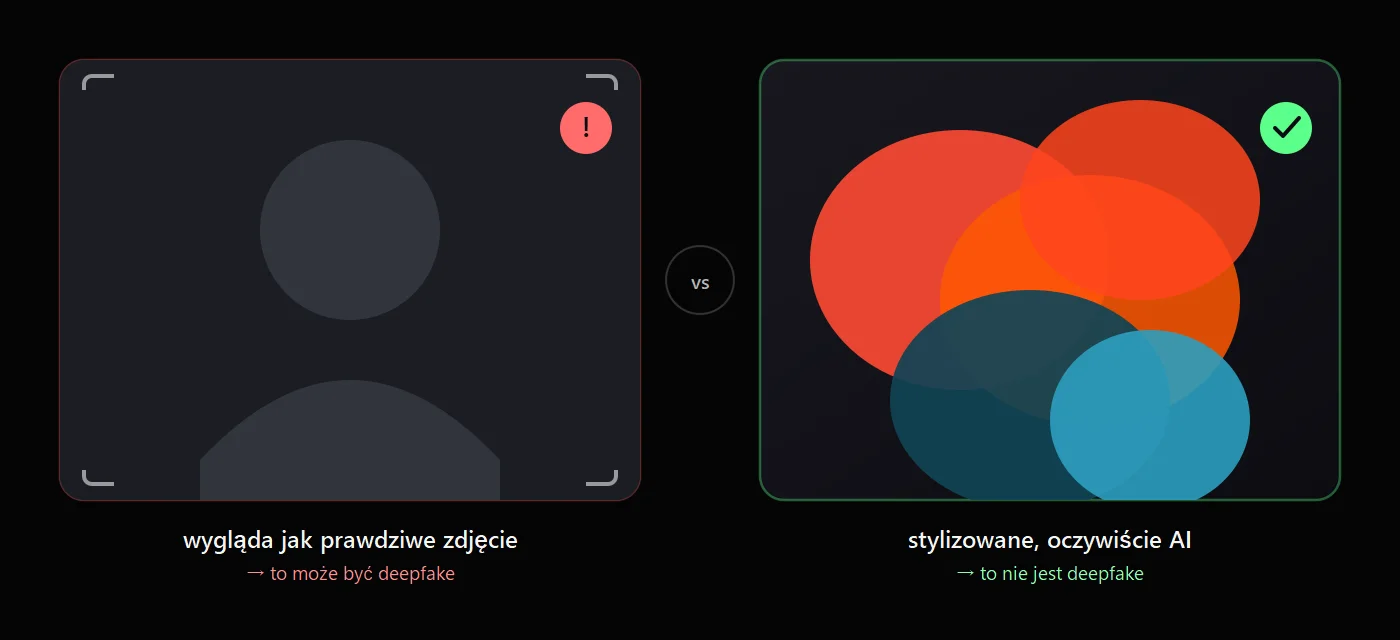
The test in practice: could you mistake this for a real photo or recording? The answer decides whether you're even in deep-fake territory to begin with.
The exemptions: when the rule doesn't apply anyway
Even when something does meet the deep fake definition, Article 50 carves out four situations where the obligation is lighter or doesn't apply at all[6]:
1. Evidently artistic, creative, satirical or fictional work
There's no full exemption, but disclosure can be minimal and unobtrusive - as long as it doesn't get in the way of enjoying the work. In practice: a small, discreet note, not a giant label across the frame[6].
2. Text under human editorial control
If AI-generated text has genuinely been edited and a specific person or organisation takes editorial responsibility for it, the disclosure duty disappears[6].
3. Assistive, minor edits
Tools that merely support standard editing without substantially changing the input content - retouching, colour correction - don't count as content generation[6].
4. Obvious from context
If it's clear to a reasonably well-informed observer that they're dealing with AI, you don't need to spell it out[6].
The EU's official icons: what they look like and how to use them
These are probably the images you ran into online. On 10 June 2026 the European Commission published an official icon set for labelling AI content, alongside a Code of Practice on the Transparency of AI-generated Content[3].
The set is three separate icons, each for a different situation[3]:
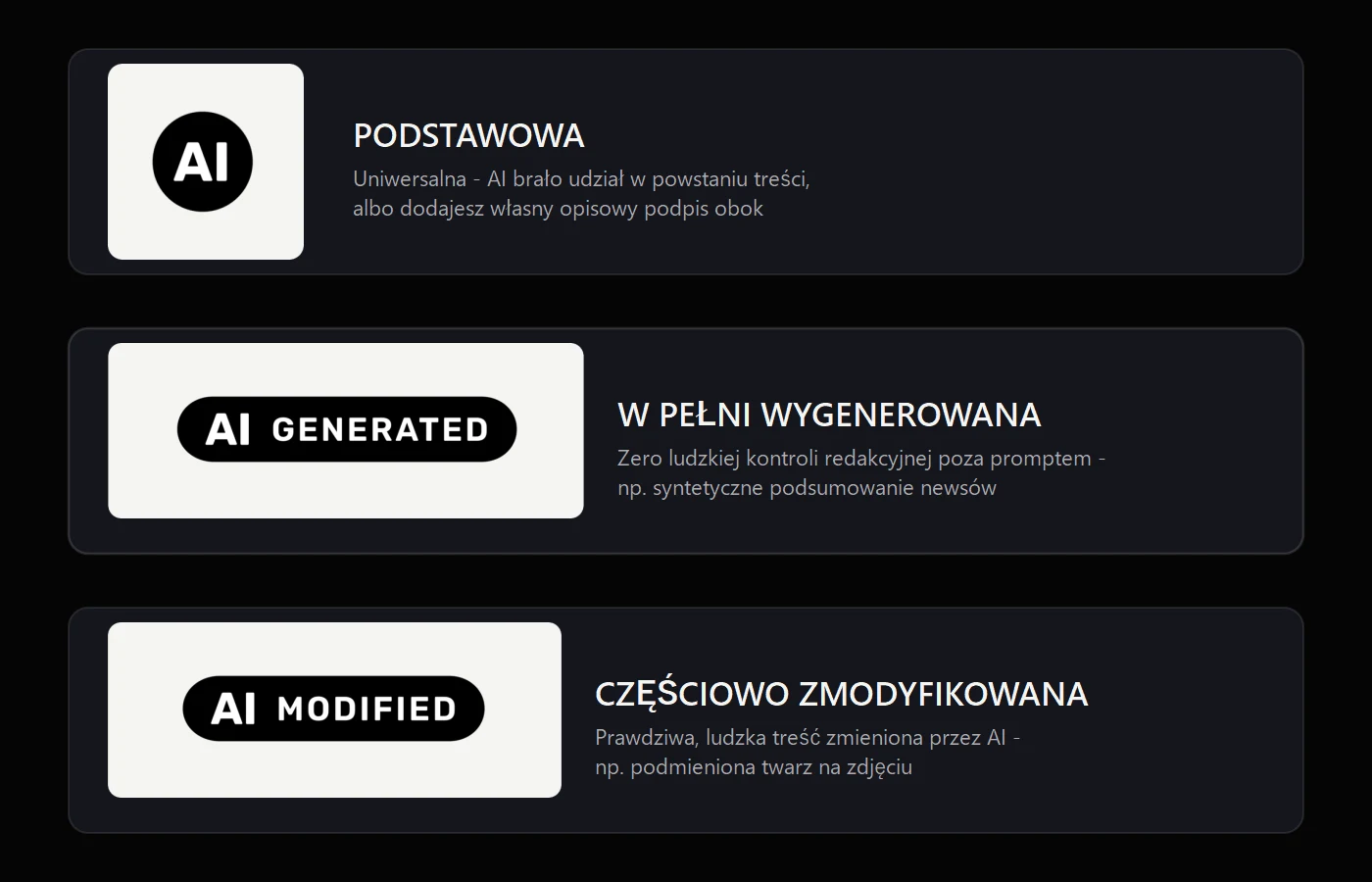
Official European Commission icons - pulled straight from there, free to use with no attribution required (crediting it anyway)
- Basic icon - general-purpose, for when AI was involved in creating the content, or when you want to pair it with your own descriptive label.
- Fully AI-generated - when the entire piece (image, audio, video, text) was produced with no human editorial control beyond the prompt. Think a synthetic news summary or a track composed entirely by a model.
- Partially AI-modified - when real, human-made content was altered by AI in a way that creates a deep fake, like a face-swapped photo or an added background.
Each icon comes in four colour variants - black, white, and the same two at 50% transparency - to work against both light and dark backgrounds. SVG and PNG files are free to download, no attribution to the Commission or the AI Office required[3].
The Commission's placement guidance[3]:
- Visible and clear from the very first moment someone encounters the content - not buried three clicks into a caption.
- Embedded directly into the content (burned into the image or video pixels), not just in a caption - except for creative work, where a lighter touch is fine.
- Stays visible even after the content is reshared or downloaded.
- Works best paired with a short, plain-language label - the Commission found that the basic icon plus a simple caption like "modified" performed better than the icon alone[3].
- Accessible to assistive technology - adequate size, alt text.
The Code of Practice: voluntary, with a real upside
Alongside the icons, the AI Office facilitated a Code of Practice on Transparency of AI-generated Content, built by independent experts. By the end of July 2026 around 190 companies and organisations had signed it[4].
Signing is voluntary, but it has real value: signatories can demonstrate Article 50 compliance across the whole EU without a separate legal assessment in every member state. Non-signatories have to individually prove to regulators that their own approach is good enough[4].
How to actually do it well - a checklist
If your content genuinely falls under the obligation (a deep fake, or AI text on public affairs with no human editing), here's how to do it properly:
- ☐ Use the official EU icon - the right variant (basic / fully generated / partially modified)
- ☐ Pair it with a short, human-readable caption, not just the bare symbol
- ☐ Place it so it's visible immediately, not tucked into a caption underneath
- ☐ Burn it into the file itself (image/video), not just the post text that vanishes on reshare
- ☐ Check size and contrast - it needs to actually be readable, not a symbolic dot in a corner
- ☐ For text: if you want to skip labelling, genuinely edit it and take responsibility for it - don't just paste the raw output
If you run a business and publish AI content regularly at scale, consider signing the Code of Practice instead of building your own compliance system from scratch[4].
Why I personally don't paste a badge under every post
Time to be honest here, including with myself - because the easy version of this paragraph would be "I don't make money from it, so it doesn't apply to me," and that would be too convenient a shortcut.
The real reason comes down to two things:
First - the technical layer isn't my job. Machine-readable marking (Article 50, paragraph 2) is Midjourney's obligation as the provider, not mine as the user[2]. More and more generators bake this straight into file metadata automatically (C2PA Content Credentials and similar standards)[9] - that layer happens without my involvement, before I've published anything.
Second - most of what I make isn't a "deep fake" under the law at all. Back to the Article 3(60) definition: the content has to resemble something real and look authentic[7]. I don't make photorealistic fakes of specific people, places or events meant to pass as real photographs. I make stylised, recognisably-generated compositions - and that's exactly the kind of content where the paragraph 4 obligation simply never switches on, because there's no attempt to impersonate reality in the first place.
Instead of tagging every individual post, transparency happens at the profile level: the bio, the account name, the AI hashtag on every single post, and this entire site is literally called "Midjourney training." Nobody who lands on this content is confused about where it comes from. That's not a loophole - it's exactly the point of Article 50: making sure the audience knows what they're looking at[1].
When I'd change my mind
If I started making realistic portraits of specific real people, reconstructions of actual events, or anything that could pass for a photograph or recording at first glance - then yes, a single, visible label on that piece would be the right call, whether the law formally required it or not. Not because a statute told me to, but because it's the honest thing to do for whoever's looking at it.
The line was never "am I using AI." It's "am I trying to trick someone about what this is." Strip away all the regulatory scaffolding, and that's what the whole article comes down to.
Want to talk through what this looks like for your own content, at your own scale? Book a consultation.
Sources
- European Commission, "Transparency obligations under Article 50 of the AI Act"
- EU Artificial Intelligence Act, "Article 50: Transparency Obligations for Providers and Deployers of Certain AI Systems"
- European Commission, "EU Icons for labelling AI-generated content"
- European Commission, "Code of Practice on Transparency of AI-generated Content"
- Cooley LLP, "EU AI Act: Transparency Obligations Take Effect 2 August 2026"
- Search Engine Journal, "EU Commission Article 50 AI Transparency Law Has Four Exemptions"
- Privacy World, "How Deep is Your Fake? A 3-Minute-Guide on Labelling Obligations under the EU AI Act"
- The Science Talk, "How to add AI disclosures that comply with the EU AI Act"
- C2PA Viewer, "EU AI Act and C2PA: What Article 50 Requires for AI Content"